

Since Nuclear Power Is Clean, Why Is It Not Used More Extensively In The United States?
Nuclear reactors supply steady, depression-carbon free energy—a valuable commodity in a world against climate change. Yet nuclear ability'south part has been diminishing for two decades. Lesser line: it'southward but too expensive.
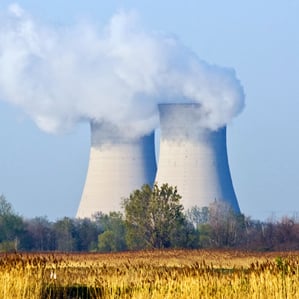
Concern over dependence on fossil fuels drove rapid growth in nuclear-found construction in the 1970s and 1980s, especially after the oil crises of the 1970s. Only nuclear safety became the business afterward the meltdowns at Iii Mile Island and Chernobyl. Meanwhile, price overruns and delays eroded investor confidence in nuclear projects. Amid low fossil-fuel prices in the 1990s, reactor sales evaporated and the industry stagnated. The share of global power generation contributed by nuclear peaked in 1996, when it supplied 17.6 percent of the world'southward electricity. Full electrical output from nuclear power peaked in 2006.
A nuclear rebound did get started a decade ago. However, the global financial crises of 2008-'09 softened energy demand, and the improvement took another blow when three reactors melted downwards at Tokyo Electrical Power Company's Fukushima Daiichi nuclear plant in 2011. In 2013, reactors worldwide produced 2,364 terawatt-hours of electricity, co-ordinate to the U.S. Free energy Information Administration, coming together 11 percent of global power demand—the share nuclear held in 1983. And last year just three new reactors started up, down from a peak of 16 in 2010 at the height of the short-lived renaissance.
Fukushima Daiichi hit the industry in myriad means. Ascent public concerns over condom shifted energy policy in some key countries. Japan scrapped plans for xiv new reactors, and all of its 48 operable reactors remain airtight for safety reviews and upgrades (run into "Can Japan Recapture Its Solar Power?"). Frg decided to shutter its 17 reactors, which had supplied a quarter of its power, past 2022. France, which however gets a higher percent of its power from nuclear than any other country, elected a president promising to slash nuclear'due south contribution from 3-quarters of the supply to 1-one-half by 2025.
The economics of the nuclear industry also worsened afterward Fukushima, according to a Jan study by the International Energy Bureau and the OECD'southward Nuclear Energy Bureau. The written report estimates that equipment costs have risen 20 per centum since 2010, in part because of heightened rubber requirements—even equally low-carbon wind and solar power got cheaper.
A 2014 assay by the financial advisory firm Lazard captures the economics holding dorsum nuclear expansion. Lazard pegs the cost of building nuclear capacity in the The states at $five.4 million to $8.4 million per megawatt. Adding operating, maintenance, and fuel costs yields an average lifetime cost of $92 to $132 for every megawatt-hour generated. That is far in a higher place the unsubsidized costs of utility-scale solar power ($72 to $86 per megawatt-hour) and onshore current of air ($37 to $81 per megawatt-hour).
Power from new natural-gas-fired plants is too far cheaper than nuclear at $61 to $87 per megawatt-hr, according to Lazard, cheers largely to gas derived from fracking in U.South. deposits. This makes natural-gas plants, rather than nuclear plants, the leading choice for utilities that want to replace coal-fired power plants as a source of constant "base load" power.
In the United States, four new reactors are under construction (in Georgia and South Carolina) thank you to loan guarantees from the federal government and additional financing support from country regulators. However, five U.S. reactors have shut downwardly in just the by two years.
The U.S. Department of Energy sees small modular reactors equally a potential solution to the economic challenges facing nuclear power, only the virtually mature designs have yet to concenter buyers. Several leading developers, including Babcock & Wilcox and Westinghouse, have recently scaled dorsum their programs. Every bit the IEA-NEA's nuclear road map observes: "It seems that customers in the Us are non yet ready for [the] applied science."
Nuclear is growing in a handful of markets where it enjoys strong government backing. China's plans, trimmed later Fukushima, nevertheless call for 88 gigawatts of nuclear capacity to be running or in construction past 2020—more than five times the output from People's republic of china'south 20 operational reactors. Russia is edifice 10 reactors.
The takeaway:
The IEA-NEA road map makes a case for nuclear capacity to more than double, to 930 gigawatts, by 2050—which would restore nuclear to its historic high of 17 percent of the global electricity supply and displace plenty coal power to cut worldwide carbon dioxide emissions by 2.five gigatons. That represents most 1-7th of the power-sector cleanup needed to limit this century's global temperature increase to 2 °C.
The IEA-NEA authors stress, however, that their nuclear vision is not a prediction. It is a plausible scenario but if governments, reactor suppliers, and institute operators deliver on a long list of proposed policy changes and performance improvements. For case, the document calls for the nuclear industry to demonstrate that it can build the enhanced-safety reactors that regulators are mandating, on time and on upkeep. Construction of such reactors, even so, is now years late and billions of dollars over budget.
Rather than producing electricity too cheap to meter, nuclear power is still also expensive to build.
Do yous have a big question? Ship suggestions to questionoftheweek@technologyreview.com

Since Nuclear Power Is Clean, Why Is It Not Used More Extensively In The United States?,
Source: https://www.technologyreview.com/2015/05/28/167951/why-dont-we-have-more-nuclear-power/
Posted by: baileymyst1960.blogspot.com
0 Response to "Since Nuclear Power Is Clean, Why Is It Not Used More Extensively In The United States?"
Post a Comment